

Table of Contents
The Patient’s Perspective
I don’t want to be
a burden
an inconvenience
an individual
known to take the doctor’s time
and throw it in the wind.
I don’t want to be
a burden
an inconvenience
a mother
who relies on her son
who works so long, so hard
and must take off work
to drive her.
If only I could magically understand
English,
I would not be
a burden
an inconvenience
a patient needing
to rely on loved ones’ words.
The White Coat’s Perspective
I want to be able to connect
with all of my patients
to inquire.
to answer.
to reassure.
But where do I find the time?
I enter the room,
where the day’s first patient
waits with her daughter.
I have to ask the daughter
if she would be alright translating.
The daughter agrees.
How convenient,
I think to myself, with guilty relief.
Ad Hoc Interpreter’s Perspective
This is very convenient.
But is it right?
What if the white coat misunderstands?
What if I misunderstand?
Why didn’t they ask my mother first?
Of course, she’d say yes
even if she doesn’t want this.
She has great respect
For the white coat.
About the Author(s)
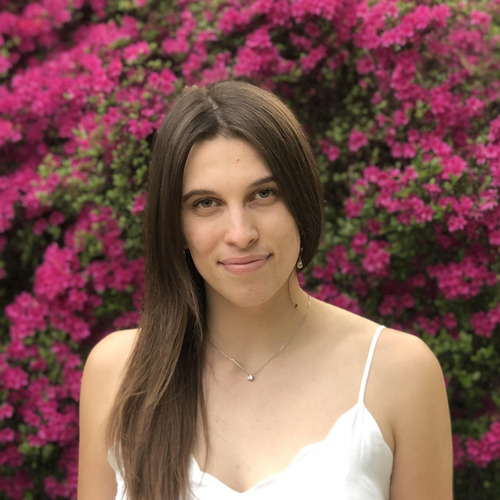
Marta Tymchenko, BS
Marta Tymchenko, BS works as a medical assistant at a pain management practice. She is a proud graduate of Penn State University with a Bachelors in Biological Sciences and Health Professions, along with a minor in Bioethics and Humanities. Through her minor, she has gained passion in advocating for Limited English Proficiency (LEP) patients in the healthcare field, as some of her dear family members identify as LEP patients themselves. She finds the importance of humanity in addressing language barriers faced in the simplicity of a patient office visit. Her piece depicts socio-cultural assumptions with LEP patient visits and an empowering patient-provider relationship, where clear communication is reassured and made a priority for the patient’s care. You can find her connecting with patients with a welcoming smile hidden behind her mask and listening intently. Acknowledgement: The author would like to thank Michele Mekel for supporting her throughout her creative journey.
This work is licensed under a Creative Commons Attribution 4.0 International License.